
Americans’ Ability to Afford Healthcare Falls to Five-Year Low
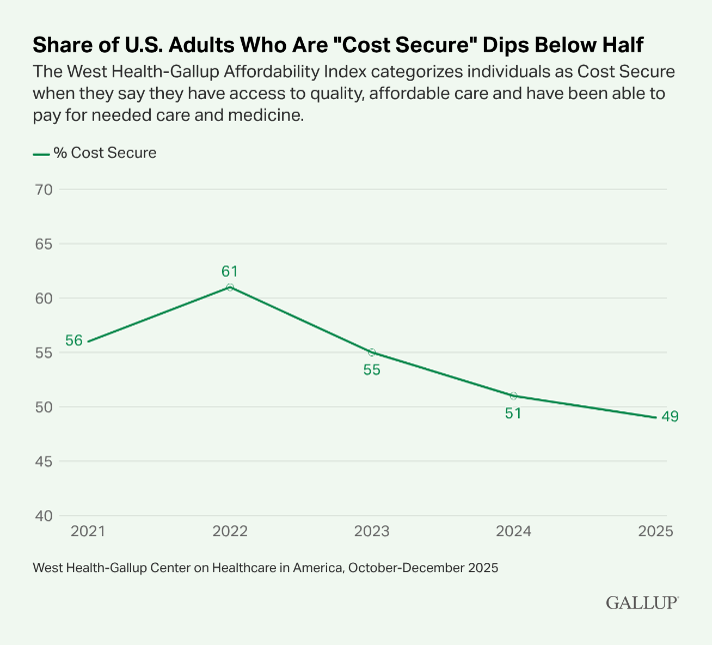
WASHINGTON, D.C. — June 18, 2026 — New research released today from the West Health-Gallup Center on Healthcare in America finds that fewer than half of Americans (49%) are considered “Cost Secure,” meaning they can consistently afford healthcare and prescription medications when and where they need them, the lowest level recorded since West Health and Gallup launched its Healthcare Affordability Index in 2021.
In the past year alone, 2.8 million Americans dropped out of the Cost Secure category, unable to keep up with rising healthcare costs. The new data largely extend last year’s downward trends, with continued declines in affordability evident among traditionally vulnerable populations, including Black and Hispanic adults and lower-income households.
“The fact that fewer than half of Americans can reliably afford healthcare should alarm every person, policymaker and healthcare leader in the country,” said Tim Lash, President, West Health Policy Center. “Millions of Americans are being priced out of healthcare because costs are rising faster than their ability to pay. Without meaningful reforms that better address healthcare delivery, high prescription drug prices and rising insurance premiums, Americans will continue to struggle and affordability will only continue to deteriorate.”
Healthcare spending is on the rise in the U.S., reaching $5.3 trillion in 2024, a 7.2% increase from the prior year and growing more than twice the rate of overall inflation (2.9%). Hospital prices climbed 3.4% in 2024, the fastest increase since 2007, while prescription drug spending rose approximately 7.9%.
The new findings about healthcare affordability come from the latest West Health-Gallup Healthcare Affordability Index, which measures Americans’ ability to access and pay for healthcare based on self-reported experiences as collected through timely, nationally representative surveys. Based on their responses, Americans fell into one of three groups:
- Cost Secure — able to consistently access and afford needed healthcare and prescription medications (49% of U.S. adults in 2025)
- Cost Insecure — lacking access to care or recently unable to pay for either care or medicine (41% of U.S. adults in 2025)
- Cost Desperate — lacking access and recently unable to pay for both care and prescription drugs (10% of U.S. adults in 2025)
Study Highlights
- Growing racial disparities — Currently, just 38% of Black adults and 32% of Hispanic adults are classified as Cost Secure, compared with 55% of White adults. Since 2021, these gaps have consistently widened, with cost security declining more dramatically among Black (-16 percentage points) and Hispanic (-19 points) adults than among White adults (-3 points).
- Middle class getting squeezed — About one in three adults in households earning between $120,000 to $179,999 were not Cost Secure in 2025, nor were even one in five earning $180,000 or more a year.
- Young adults struggling — Adults aged 18 to 29 saw the sharpest decline in healthcare affordability. Less than a third of this group (32%) were Cost Secure in 2025, a 17-point decline since 2021 and a seven-point drop in the last year alone.
- Troubling trends for older adults — Though largely covered by Medicare, cost security among people 65 and older fell from 73% in 2021 to 61% in 2025, one of the sharpest declines among age groups.
- Chronic conditions straining affordability — Little more than a third of people with COPD (34%) or compromised immune systems (38%) were Cost Secure in 2025, about equal to the share of people reporting mental health conditions including anxiety (39%) or depression (37%).
- Gender gap reaches record high — Women have been less Cost Secure than men since 2021 and the gap is growing. In 2025, 42% of women were Cost Secure compared with 57% of men — the largest difference on record. Women were six percentage points less likely to be considered Cost Secure in 2025 than the previous year.
The future appears grim and uncertain for millions of Americans who are increasingly worried about their ability to pay for healthcare in the year ahead. According to the West Health-Gallup Healthcare Affordability Index, worry rose from 42% of respondents to 51% and concerns about paying for prescription drugs jumped to 42% from 30% between 2021 and 2025.
“The new findings point to a sustained shift in how Americans perceive the affordability of healthcare,” said Joe Daly, Global Managing Partner at Gallup. “Since 2021, the share of Americans who say healthcare is affordable has declined steadily, suggesting this is part of a longer-term pattern rather than a one-time drop since last year.”
Survey Methods
Results are based on a Gallup Panel study completed by 5,660 U.S. adults ages 18 and older, conducted Oct. 27-Dec. 22, 2025. The Gallup Panel is a probability-based panel of U.S. adults recruited via random-digit-dial phone interviews and address-based sampling (ABS) methods. Respondents with internet access completed the survey online; those without regular internet access were sent a printed questionnaire to complete and return by mail. The sample was weighted to be demographically representative of the U.S. adult population using the most recent Current Population Survey figures. The maximum margin of sampling error is ±2.1 percentage points at the 95% confidence level. Margins of error are higher for subsamples. Prior-year surveys were conducted as follows: 2024 (n=6,296, Nov. 18-Dec. 27, 2024); 2023 (n=5,149, Nov. 13, 2023-Jan. 8, 2024); 2022 (n=5,551, June 21-July 1, 2022); 2021 (n=4,843, Sept. 27-30 and Oct. 18-21, 2021).
About the West Health-Gallup Center on Healthcare in America
The Center on Healthcare in America is a joint initiative from West Health and Gallup dedicated to elevating the voices and experiences of Americans within the healthcare system. Through rigorous research and human-centered storytelling, the Center aims to drive actionable insights and inform policy solutions nationwide. Visit westhealth.gallup.com.
About West Health
Solely funded by philanthropists Gary and Mary West, West Health is a family of nonprofit and nonpartisan organizations that include the Gary and Mary West Foundation and Gary and Mary West Health Institute in San Diego and the Gary and Mary West Health Policy Center in Washington, D.C. West Health is dedicated to lowering healthcare costs to enable seniors to successfully age in place with access to high-quality and affordable health and support services that preserve and protect their dignity, quality of life and independence. Learn more at westhealth.org.
For more on the data and drivers behind healthcare affordability, visit westhealthmosaic.com.
About Gallup
Gallup delivers analytics and advice to help leaders and organizations solve their most pressing problems. Combining more than 90 years of experience with its global reach, Gallup knows more about the attitudes and behaviors of employees, customers, students and citizens than any other organization in the world.
###